Sandstone and Pearl
There’s no shortage of advice out there when you’re trying to be a writer, and so much of it is about how much you need to write if you want to make a living at it. A book a year, a book a month, lots of books, all the books! Perhaps luckily for me, I know I’m not that writer. As someone who can take years to finish a piece of flash fiction (Dining on Rose Petals took about two years from first line to finished story, and I could not have done it in less time, and this very blog post was started in August of 2025) I have the dubious privilege of laughing these recommendations off—knowing beyond a shadow of a doubt that I simply cannot meet them—before moving on with my life. Why can’t I meet them? Well, I’m slow. I learn choreography slowly, I read slowly, I think slowly, I master concepts slowly, and yes, I write slowly.
But how do I know I truly write slowly? Maybe I’m just busy, lacking the time or energy I would need to be more productive? No, that’s not it. You see, I’ve been conducting a bit of an experiment over the last two years or so: I stopped working because my husband landed his dream job. Yes, I am a kept woman. A stay-at-home-cat-mom! (Discuss: Is Marisa Celeste Montany a bad feminist, the worst tradwife, or somehow both?!) So yeah, it’s not that. But having lucked into this newfound freedom, I wondered what would happen if I took this extra time and used it to focus on writing more seriously. For the first time ever, here I was in a position to prioritize writing over most other things. And the conventional wisdom is that more writing time is better! More space for writing is better! And yes, in some ways I’ve certainly found this to be true. There really is no substitute for not having a 60 hour work week. But what I’ve found it doesn’t do—at least for me, at least right now—is make the stories accrete more quickly. Because that’s what my stories do: they accrete. Like sedimentary stone, or circumstellar discs, or other things that proceed along geologic and cosmic timescales that make humans feel infinitely small. And it turns out there’s an upward speed limit, like the speed of light.
Now, what I can do is have more stories in process at once, which means more stories get finished. But if I try to force it by say, setting a word goal every day, I’ve found it’s actually counter productive for me. Sure, I’ll write words. But the result has a feeling similar to that of a toddler being allowed to pick their own outfit. Yep, those are clothes! And like, wow, so individual. But the shoes are on the hands, and well, it’s cute, but it’s not like anyone one else could wear this outfit. I mean, there’s an art to picking the right outfit, especially for occasions of gravity. It’s cute to wear your toddler-chic around your own house, it’s um… not cute to wear it to a funeral. And asking other people to read your writing is an event of gravity. My toddler-chic isn’t enough! And that’s apparently what I get when I try to speed the writing along with “focus” and “discipline”: Toddler-chic.
This was a difficult thing for me to to come to, I think because it’s just not how it’s supposed to be. I could practically hear people scoffing, “You’re living the dream by having the time and space to prioritize writing, and you’re not writing exponentially more? Wtf? What a waste. If that was me, I’d have finished a novel by now.” And yeah, I hear you. And honestly, yeah, you might’ve! But I also don’t know what to say. I kind of expected it to work that way too. I confess myself surprised that it didn’t. And who knows? Maybe it will in the future. But right now? No.
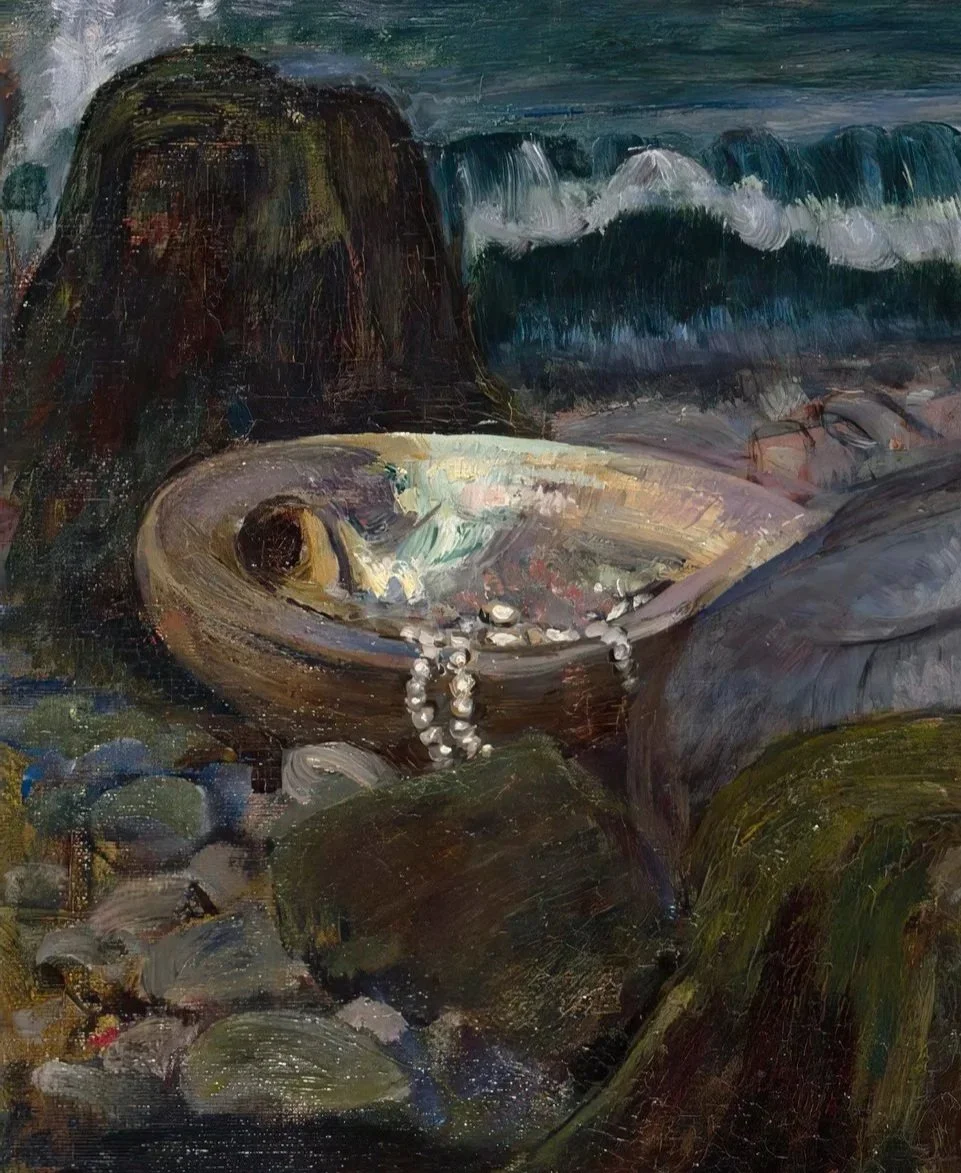
I’ve learned that my writing actually happens while I’m doing seemingly unrelated things. My stories, it turns out, are made of sandstone and pearl, laid down slowly in the deep dark, grain by grain and layer by layer while my mind is occupied by the puzzle of how best to arrange my pantry cabinet to minimize the chance that I will be knocked unconscious by a particularly opportunistic can of beans falling on my head. (I say opportunistic because I can only imagine the beans dream of escape; why else would they take such a risk?) Anyway, not only do I not seem to be able to change this process of mine, I don’t think I want to. Is this a problem? I mean, maybe. It certainly impacts my visibility as a writer, and it’s certainly one of the primary reasons my online presence is restricted to this website. I could never keep up with the pace of Substack, much less TikTok. Here, I can calibrate the pace to my actual rhythms, which are much slower than is rewarded by any algorithm. But there is, of course, a cost to making that choice: I’m not exactly discoverable.
I do want to make one important clarification at this point: I don’t think people who write quickly are bad, or doing it wrong, or that the work they create is inherently shallow and terrible. I’m only saying that I personally don’t seem to work that way. And one of the many things I learned from ballet is that you are much better off accepting the gifts your body actually has. I was a great jumper and a challenged turner, and the sooner I accepted that this was just how my anatomy was, the sooner I could stop beating myself up about it. This feels fairly intuitive with the body—or it will if you’ve ever seriously challenged it—but for some reason, we think that the realm of the mind should be somehow different; we think the mind is immaterial and that therefore it should be able to adopt any process we like!
But this just isn’t true. While the seat of consciousness may be a mystery, the mind is firmly situated in the brain (mostly. probably. more on that some other time…) which is very much not immaterial. Let that sink in: Your mind is part of your body. If you doubt this, stay awake for 24 hours and tell me how your mind is feeling. Ergo, the mind will have limits, capacities, inherent preferences based on its structure, etc. just like the rest of the body does. In some very important ways, the mind is not subject to your will in the same way the length of your legs is not subject to your will. Of course, you can choose how to direct and use it, and you can absolutely train it, but a given mind has a native way it wants to do things, and no amount of optimizing is going to be able to totally override that.
If you’re like me, what you’ll get from setting word goals, or telling yourself that you can only edit what gets on the page, is toddler-chic. This is because part of the creation process will have been circumvented: The part where you compose lines while cleaning the toilet, or turn over themes while watching your feet avoid tree roots, or realize that that cool thing you just learned from the book you’re reading is the missing piece that makes the partially finished story make sense. No journey to the desert will have taken place. No dew will have been collected from the cupped leaves of the Lady’s Mantle. There will have been no sojourn beyond the self in search of a truth worth bringing back and articulating the way only you can. Indeed, were I to follow the prevailing advice, such quests would rather need to be actively avoided. They take so much time, and worse, I can never predict how long I will be gone. I find that as a result of being thus “optimized,” the nature of my creativity itself is altered; it is no longer the act of becoming a lens for a beauty greater than my own—what I get from undertaking the journey—instead, I get an interloping sort of aggressive assertion of the self as island. Because that—by definition—requires no journey, and can therefore be produced more quickly. Oddly, we often call the result of this interloping creativity authentic. It is completely self-referential, and the less connected, the less contextualized, the less resonant, the more authentic it appears to be.
But what do we mean by authentic? A lot of times I think what we’re actually referring to is idiosyncrasy, and more than that, we’re taking a snapshot of our idiosyncrasies at a single point in time and generalizing them to say something foundational and absolute about who we are as a person. Put another way: Your toddler-chic is who you are. As if you had a changeless bottom. Like a bucket. But you are not a bucket! I’m not a bucket! We are shallow seas replete with color, and movement, and the soft susurrus of life. Our skins are carved by currents and waves into the most beautiful fields of ever-changing ripples; they will never be the same twice. We are not islands, but the seas that flow between them. We touch everything, we contain everything, we hold everything. It’s the old medieval idea of the human body as a microcosm of the cosmos. True authenticity, the kind you get from a journey, reflects the cosmos contained within you while the glorification of idiosyncrasy above all else denies it. True authenticity is cosmic fire refracted through the singular jewel of your heart. This feeling is what I create for. It’s why I danced, it’s why I write, it’s why I sing songs to myself, it’s why I take walks. Oh, I know, guys, I’m so uncool. But I need the journey. I need to find the fire. I need it like I need water, and food, and air. And for me, the fire doesn’t come in lightning flashes or roaring torrents; it comes one candle, one firefly, one phosphorescent jellyfish at a time.
We live in a culture that equates slowness with lack of ability or understanding, but this doesn’t really make sense. Plants grow slowly, but we’d never suggest that this indicates some kind of incompetency on their part. That would be ridiculous. We need to extend this understanding to the more ephemeral realms of the mind, ideas, and creativity. Some people have very straight legs that allow them to turn easily, some people have tibial torsion that allows them to jump very efficiently, some people have shallow hip sockets that allow for astounding ranges of motion. Some people have minds that sparkle like crystal and assimilate information very quickly, some people have minds that dance like wind, some people have minds that grow steadily like trees, and some people have minds like the ocean, deep and slow but powerful once roused. My mind is like the ocean—it gifts me sandstone and pearls. And while I admire and enjoy the creations of my crystalline and blustery brethren, me and the tree-mind people will simply never be like them when it comes to speed. And that’s fine. Indeed, it’s more than fine, it’s wonderful! This diversity is a gift, and its flattening in the name of pleasing the all-powerful algorithms is a theft. We once stole fire from the gods, and now it seems the new gods have come to steal it back.
So what is a slow writer to do in the age of algorithms and visibility and whatever else I‘m supposed to be thinking about but don’t? I suppose there are three options: Try to adapt, try to find a middle ground that preserves process while supporting productivity, or stick to our natural rhythms and accept that it will likely consign us to obscurity. I cannot speak for anyone else, but for me, when I’ve attempted option one and tried to calibrate my creative rhythms to meet the imagined demands of the market/algorithm/whatever, I find the only thing I succeed at is robbing the art. This feeds right into my natural, somewhat stubborn, inclination: to go straight for option three and revel in the obscurity. But I find myself wondering, should I make an attempt at option two? Can I preserve my process, but also produce more writing? In other words, can I create the conditions that would encourage the stories to accrete? I think the answer to that question is actually yes, to a point at least. And that will be the subject of my next post.
The art featured with this post is a detail from John William Waterhouse’s “A Mermaid,” 1900. Sourced from Artvee.
