“It’s all junk!”
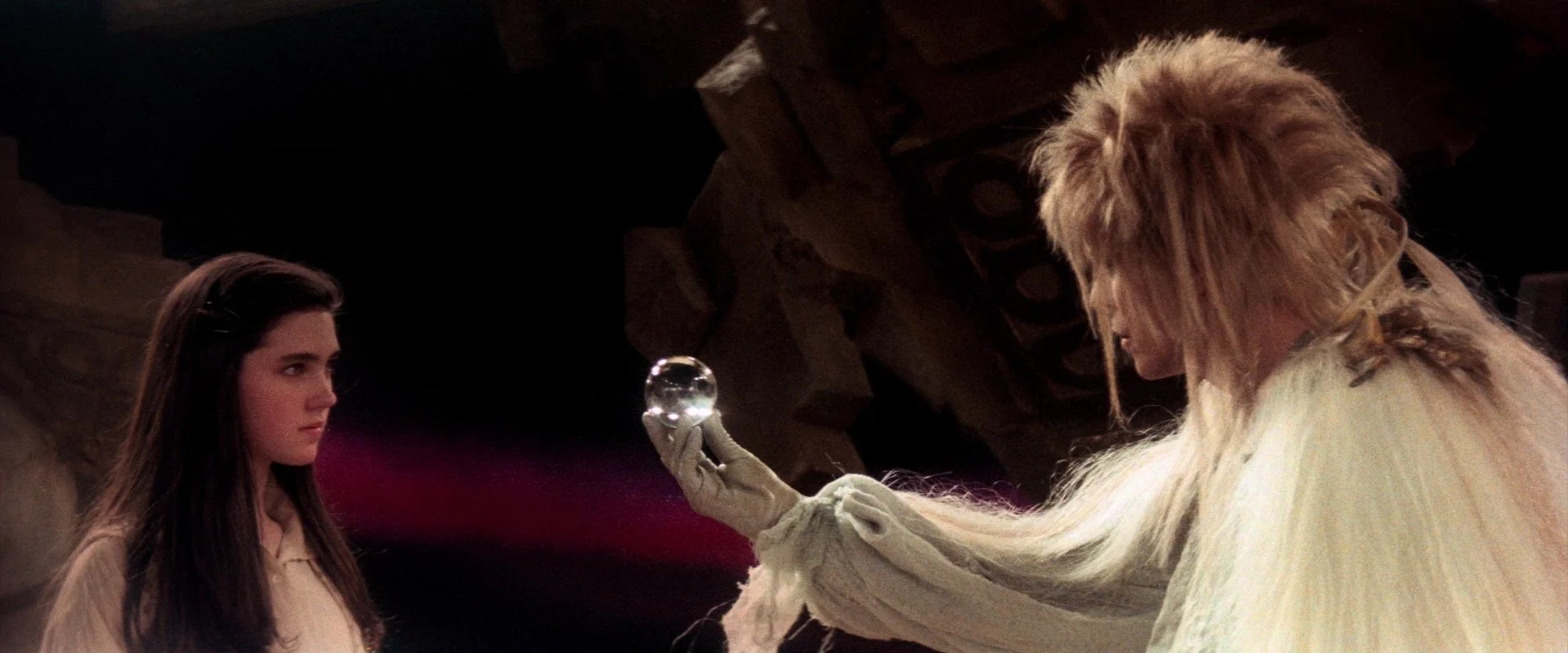
Well, it has been a strange, wild, interesting three months for me, as evidenced by the (mostly) uncharacteristic dearth of blog posts. But for all that, it has been a quietly fertile time. What happened, you ask? Well, I moved unexpectedly. Not far, only ten minutes down a winding road. But wind the road did, and the move ended up being a journey all its own. It is this, the unexpected move and the dark wood it nudged me into—or out of—which I want to explore today. And I want to do it with that most masterful of 80s fantasy films, Labyrinth!
Now, for the purposes of this post, I’m going to assume that you have seen Labyrinth. And given that you are here reading my blog, I think there’s a pretty high chance that you have. But in case you haven’t, it’s an 80s fantasy movie starring David Bowie as a Goblin King! If that doesn’t sell you, I don’t know what will. I’m sure it’s streaming or available to rent for less than $5 somewhere. Go watch it!
So, about this move. The move was unexpected, but positive. We chose to move, we did it on purpose, and we are happy we did it. Actually, we are very happy we did it! But we almost didn’t, and this is why: We’d have to downsize.
Now, while I’m sure there are some natural minimalists out there, for most of us, downsizing strikes fear into the clutter-clutching gremlin that resides quietly in the junk drawers our hearts. Getting rid of things is hard. Letting go of things is hard. Deciding what stays, what has become (or always was) garbage, what no longer fits (literally and metaphorically), and what might be of use to someone else is exhausting in a way that few things are. And it’s not just the sentimental things that are difficult, because just beyond your peripheral vision there’s the hulking specter of the reasons why you have so much stuff to begin with: dopamine shopping, deep insecurities, dashed hopes, grief, and not least the sheer dominance and ubiquity of cheaply made objects that will spend about two years in your home being mediocre before spending the next million as microplastics.
It’s just… a lot. And my husband and I only had a one bedroom(ish?) apartment. No basement, no garage, no attic, not even a storage closet. By American standards, we already didn’t have that much stuff. But it all never quite fit in the apartment. We’ve moved a lot in the last five years. We got tired. We let more than I’m proud of stay in piles of “someday I’ll figure that stuff out….” So the prospect of moving in somewhere even smaller? It was daunting.
But the new place was better. In addition to having better light, better air flow, more privacy, more quiet, outdoor space, and better landlords, the new place was $600 cheaper per month; the old place was about to get even more expensive when we signed a new lease. It was a no-brainer. We should move to the new place. But going through our stuff…. we couldn’t do it until we asked ourselves a question: Were we willing to pay $600 a month to avoid going through our stuff? The obvious answer was no. And so we made our decision.
Now to be fair, when I say “we” needed to downsize, it was mostly me. My husband collects ephemera—lanyards from conferences, random things someone handed him somewhere. He rarely buys things, but he also keeps everything. He had to downsize too, but not like I did. I still had clothes I hadn’t been able to wear since I was an aggressively in-shape 25 year old ballerina. I had all my dancewear, even though I’ve been retired for nearly ten years. I had rocks and bits of ribbon. I had a small totemic collection of teenage Marisa’s favorite tops. I had my deceased sister’s clothes, lots of them. Everywhere, I had tiny memorials to versions of myself that were no more. Everywhere, my past was enshrined, or more often, guiltily entombed in an Ikea Kallax cube in the closet. I’m not a hoarder—I’ve let plenty go over the years—but I am a sentimental pack-rat.
In my defense, it’s not hard for me to look at my life and see where this tendency arose. And whatever combination of nature and nurture made me like this was no doubt infinitely compounded by watching The Brave Little Toaster too many times as a small child. (Seriously, that movie… Like, I’m all for telling kids the scary versions of fairy tales and giving them complex stories that don’t shy away from life’s darkness, but The Brave Little Toaster is where I draw the line.) It makes sense that I’m like this. And now, here it is: the compulsion to keep. To preserve. Here it has always been.
Do I still want that compulsion? Or more to the point: Is it really the stuff that needs to be decluttered?
As I set myself to the task, I realized that not only did I not actually want a lot of the stuff, I also didn’t want the compulsion to keep it. It was stifling me, and limiting me. But you can’t just wish something like that away. If I wanted to be rid of the compulsion, if I wanted to be able to live and move with ease in an even smaller space, I was going to have to turn and face it. Investigate it. Eviscerate it. Thank it. Bury it with honor. If I wanted to make space for the person I could grow to be in my fast-approaching forties, I was going to have to be very honest with myself now. This has been a theme lately. Maybe it’s because I will be turning 40 next year, and I’m realizing that if I allow the rest of my life to be one long continuous grasp for what has gone and is not coming back, I’ll never do anything new. If I keep all these totems from my past, I’ll literally have no room for my present or my future. If I can’t let go, this will be all there is. This was a scary thing to encounter. It felt very big. Perhaps ironically, it was one of the most deeply sentimental pieces of media in my universe that helped bring it into focus: Labyrinth.
I love Labyrinth, I always have and always will. Labyrinth doesn’t just “hold up” upon adult rewatch; Labyrinth was never not amazing. Its awesomeness is as uninterrupted and continuous as the skin of a calm sea. And I happened to watch it just before all this wild, transformative strangeness with the move emerged. Without any inkling of what was coming, I was struck anew by how deep the story is, and especially by Sarah’s relationship to her past, and specifically the objects that represent it. By some twist of fate or condescension of providence, I was being primed for the journey I was about to go on before I even knew I was going to be offered the chance to go on it.
And I think we all know which scene illustrates the dangers of not letting go better than any other: The Junk Lady. In case you need a refresher: There’s a scene near the end of the movie, at its lowest point, where Sarah finds herself in a facsimile of her bedroom. An old goblin woman—her back grossly encumbered with stuff—is trying to distract Sarah from her quest by piling her with her very own special, cherished objects. In a moment of clarity, Sarah says “It’s all junk!” At which point the goblin woman hands her the most special of the special things—a music box, in which a doll version of Sarah is dressed like a beautiful princess but trapped forever behind glass, in a time loop, dancing to the same song for all eternity. The old goblin woman says “What about this? This is not junk.” Sarah looks at the music box, and for a moment we fear she will allow herself to be entranced, but instead she angrily hurls it away saying, “Yes, it is! I have to save Toby!” She has beat the anesthetic lure of her precious things, her precious time-locked concept of self, and remembered that she has shit to do. It’s up to Sarah and Sarah alone to save her baby brother from the Goblin King.
This scene always made me a bit uncomfortable when I was little. I identified a lot with the character of Sarah, I still do, but I just couldn’t understand this moment. How could she say that? All those special things that were clearly so important to her, that tethered her to a cherished and perished past? It was a bridge too far. Was this not a betrayal of all that those objects represented? Of herself? Of people, and places, and times that she loved—versions of herself—that could never be with her in her present in any other way?
The scene scared me, because I knew I would never have made it out of that junkyard. I would have failed in my quest. To be fair to small me, I was like, seven, when I was having these thoughts. But it still scares me a bit. I still have a sense that I might just die in the junkyard, encrusted, encumbered, and entranced by all those lost worlds, frozen forever inside all my precious things.
And more frightening still, I’ve realized that the heaviest of these things aren’t objects at all: The stuff isn’t half as heavy as the belief that I am required to keep it. That baseline assumption sits just beyond my peripheral vision, behind me, driving me, weighing me down and dragging at my step in secret. It has camouflaged itself so well. You see, this is a belief that feels like a virtue.
I appreciate things. I alone understand the incalculable value of what has been lost, or might be lost, and I mourn it. Simpler times. More innocent versions of myself, and everyone else too. A purer world. A right-er world. I honor these things. I preserve them. They live on in me, or rather, in the bin in my closet, in the little cabinet. I sacrifice my present and my future upon their altars. I selflessly and uniquely abdicate the responsibilities of the here and now to be a votive to the past. The others can continue, but I will stay. They can continue because I will stay. I will be the memory of all. And I will pin it all in place, with carefully chosen things. Like an enchantress laying out her eye of newt and wing of bat, just so.
Sounds nice, doesn’t it? Virtuous. Lofty. Of course, this isn’t a role I thought about and consciously selected. But it’s nevertheless a real part of my mythology about myself, one that invisibly informs my real actions, or lack thereof. Even as a small child, I made a webbed museum of my world, and it’s only recently that I questioned it at all. It had all felt so moral. It felt like I was doing something capital-G-good. It felt like purpose. My purpose. It felt noble. It felt seductive.
And this is where the Goblin King himself comes into play. Now, I’m certain there are hot takes all over the internet about how creepy it is that this immortal Goblin King is trying to seduce this teenage girl and omg, was that, like, fine in the 80’s? To which I say: Stop treating stories like they’re real life! The dynamic between the Goblin King and Sarah exists because she is both in thrall to and in conflict with a very powerful force within herself. And that force is dangerous. In fairy tale logic, this malevolent but seductive force gets externalized as a malevolent but seductive king, and the immortal/teenager age difference highlights the gravity of what Sarah is up against. Ok, now that we’ve gotten that out of the way…
The Goblin King is the gravitational pull of Sarah’s past. He offers Sarah a facsimile of power. He offers her the feeling of certainty, of being chosen. He gives the illusion that she can have him—and all the power he wields—within her power, if only she submits herself to his power first. With him, she can be a princess, a queen, but only ever of the world inside that music box. Which, well, is tempting, because who’s to say that the music box world isn’t all there is? This is even literalized in the ballroom scene. Sarah can have, and be, everything she’s always dreamed of. The most powerful force in her world has singled her out as special, chosen. As too good to look after a screaming baby. She is meant for something higher. She alone has been chosen to escape the mundane world with its pains, and complexities, and responsibilities and dwell forever in this world of fantasy. He is literally offering her her dreams. That’s… pretty seductive. And all that is asked of her in return is that she give up her real power first. If she chooses, she can be the consort of a lost world, dwelling forever in a pocket universe, forever just barely too enchanted to see that it is scaffolded with grief, and fear, and loss.
I think it is significant that what ultimately allows Sarah to defeat the Goblin King is the one line from a cherished play that she can never remember. This play, the physical book Labyrinth, is clearly one of her totemic objects. And indeed, the parts of it she has already internalized help her to resist the Goblin King’s allure and influence. But it’s the line she has never successfully integrated that breaks the spell when she finally does: “You have no power over me.” Because it is about power. It is about agency. Living in the past has a numbing, stultifying effect. It robs you of all your power to act in the present. And for some of us, that’s what makes the past, and our little totemic collections, so attractive and so hard to put down. Some of us are happy to give our power away. We are exhausted, we are scared, things have gone badly for us before, and we are sure they will again. But this is not right. Because that power is still ours; it can’t really be given away. The past, our own fear, our pain, these things have no power over us. Or rather, they have only the power we cede to them. But also, they are not to be denied, or purged. Clean slates aren’t real. Our experiences can and often do have a continued and permanent impact on us. We will all collect scars. But that is not the same as those scars having power over us in the present. Let us not keep the wounds open.
At the end of Labyrinth, after the quest is completed and Sarah has returned home. We see her in her room, lovingly putting away the mementos of her cherished past and her deceased mother. Not throwing them out with a brash “clean slate” attitude, but lovingly, with a smile, just putting them away. She has stepped out of her frozen fantasy world to take her place in the real one. But then, all her fantastical helpers appear in the mirror, to reassure her that should she need them, they will be right there, in the mirror, meaning within herself. Sarah tells them that she does need them, maybe not all the time, but sometimes she will need them.
There’s wonderful richness here. Sarah was using her fantasy world to escape, and not in the healthiest way, and while she wasn’t wrong to do so, it also wasn’t a place she could stay. But she also does not need to abandon it wholesale, indeed, she shouldn’t! After all, she would never have defeated the Goblin King and rescued her baby brother without Ludo, and Hoggle, and Sir Didymus, and even Ambrosius! These parts of her—her imagination, her courage, her creativity, her willingness to look into and beyond the mundane and see more—are her greatest strengths. But they must be deployed properly, in the service of Sarah living her life, not in the service of entombing her. Even as she puts the objects away, what they represent persists within her, ready to spring to action at the smallest call. They are not betrayed, rather, they reach their fulfillment. They exist fully as aspects of her, helping her navigate her real world and grow into a more dynamic, mature version of herself.
I have no divine mandate to keep 5 shirts from when I was 15 in a bin in my closet. No judgement will be pronounced upon me if I give away my sister’s Dr. Martens that are too big for me and will only rot in my keeping. My dancer self will not be magically wiped from my muscle memory if I let the leotards go. I will not evaporate. No one else will evaporate. The past will not evaporate, because it lives on in me like tree rings beneath my skin, whether I keep the things or not.
So yes, it’s all junk. It is. That’s not to say I’m going to get rid of all my favorite nick knacks and become a hardcore minimalist; it’s just not who I am. But I can love and appreciate an object, and the lost worlds attached to it, without beaching my heart on it. I can keep some things, for purely sentimental reasons, without keeping everything. I am allowed to let go of things I never would have dreamed of parting with ten years ago but don’t feel the same way about now. I can make space for my life as it is today. I do not need to exist solely as a handmaid to what is gone. I do not need to be frozen. I am allowed to change.
If it so happens that you are like me, and you want to let things go but feel like you can’t, maybe watch Labyrinth. And pay special attention to Sarah’s relationship to her totemic objects and the lost worlds they represent. Think about those glass orbs the Goblin King keeps offering Sarah. What does it mean when they turn into a snake? Rotten fruit? A bubble that bursts at Sarah’s slightest touch? Let it help you uncover what might be going on within yourself. And I am not advocating for getting rid of things it would cause you pain to lose. Never. Do not force or coerce yourself. Keep rocks and bits of ribbon that you truly love, but know you don’t have to. Know that what that object means to you does not reside in the object; it resides within you.
I did not anticipate facing all of this when we decided to downsize. I thought, “I’ll get rid of those clothes that don’t fit anymore.” But when I actually started to do it, I quickly discovered why I hadn’t already done it. And it was all of this. I had an entire posture towards my identity and place in the world that I had never questioned, never even seen. It was just the water I was swimming in. But once I caught a corner of it, I couldn’t unsee it.
We took over three Subarus full of items to the donation center. We put quite a lot of trash bags in the dumpster. I threw rocks and dried flowers into the woods. It wasn’t easy, and I could only go through things for a few hours a day, but I’m glad I did it. Or rather, I’m glad I’m still doing it. Because of course, as we unpack, there’s another round of editing to do. I am not finished. But the momentum I’ve gained is immensely helpful, and not just for the continued decluttering process. I’ve also found myself more able to tackle things I’ve been putting off. I’ve lodged myself more firmly in my present circumstances and milieu. I am, with setbacks, building a greater tolerance for living with uncertainty and am slowly internalizing the reality that, really, you don’t get to keep anything. What you do get to keep is the universe inside you. And it, mercifully, isn’t dependent on stuff. Not that stuff is bad; I am still a sentimental pack rat and have no interest it the minimalist aesthetic. It’s not that. It’s about not letting the stuff—and all the lost worlds it represents—rule you. It’s clearing space for growth in the present, because the present and the future are what actually need you. And you deserve a future as much as anyone. And that future needs space.
The art for this post is a screencap of Labyrinth, copyright Tri Star films 1986. Sourced from movie-screencaps.com.
